What Size T Hinges Should I Use? A Practical Guide

Published: 1 May 2016 | Last Reviewed: 17 September 2026
This guide is part of our regularly reviewed content series, ensuring the advice remains useful for your home project.
Author: Carl Benson
Carl is the founder of Suffolk Latch Company, with a background in engineering and over 20 years’ experience in home hardware. He works closely with suppliers and designers alike to develop quality ironmongery that stands the test of time. Read my full bio.

Introduction
T hinges, also called tee hinges or strap hinges, are a traditional choice for ledge and brace doors. They are particularly popular in cottages, barn conversions and period-style interiors, where their long strap creates a strong visual feature across the face of the door.
Choosing the right size is about more than appearance. Door width, weight, construction, frame details and fixing method all affect which hinge is appropriate. This guide explains how to choose a proportionate T hinge, how many hinges you may need and how to fit them neatly.
Table of Contents
- What Are T Hinges Used For?
- How to Choose the Right Hinge Length
- How Many T Hinges Does a Door Need?
- Choosing Suitable Screws and Fixings
- Straightforward T-Hinge Fitting Advice
- Matching T Hinges with Traditional Hardware
- FAQ
What Are T Hinges Used For?
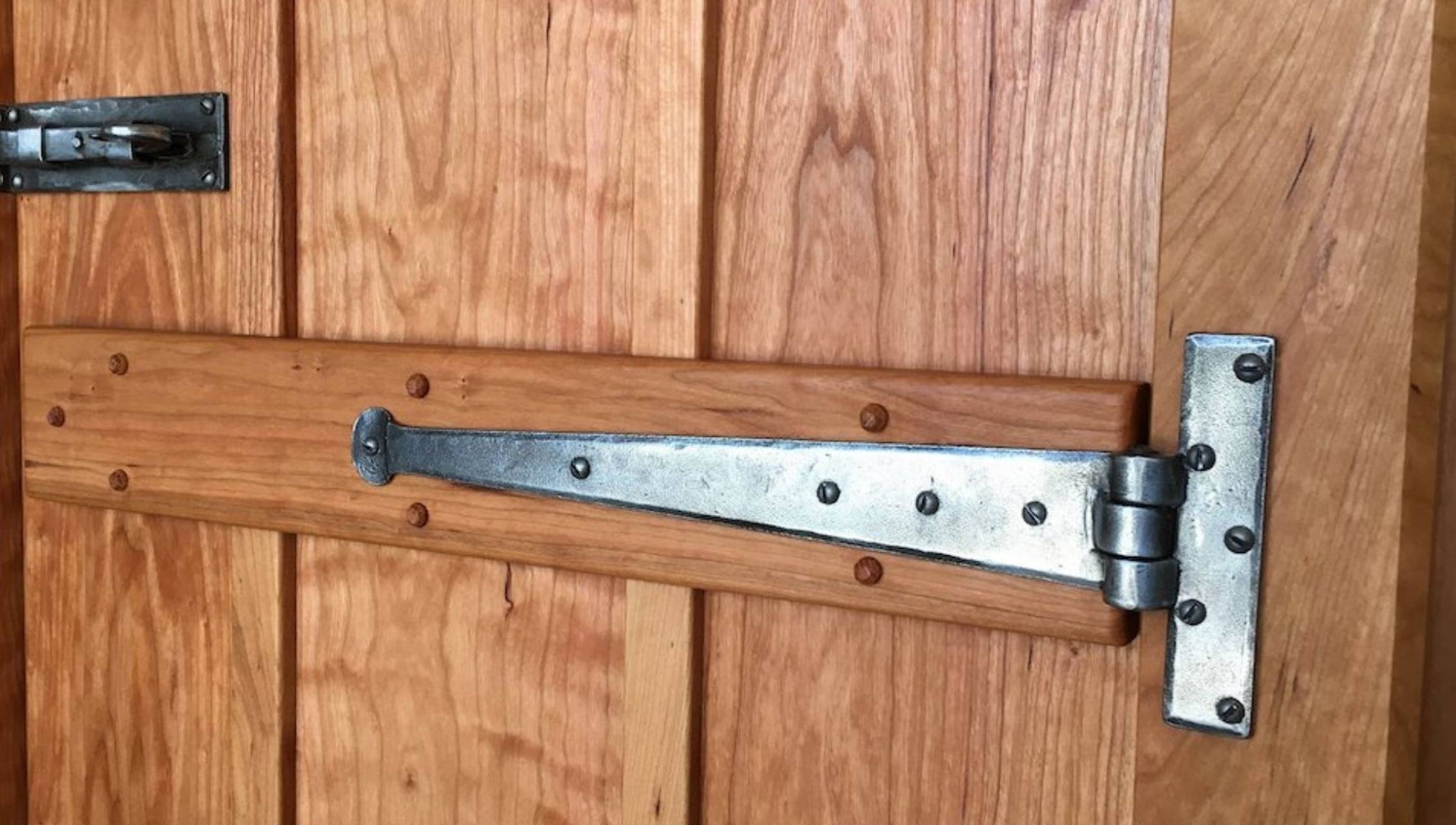
T hinges are designed for timber doors, particularly ledge and brace doors. The long strap fixes across the door face, while the shorter T section fixes to the frame or door surround.
Historically, the strap helped support doors made from vertical timber boards. Modern ledge and brace doors are usually constructed more robustly, so T hinges are now chosen for both their practical function and their traditional appearance.
They are commonly used on internal cottage doors, pantry doors, utility-room doors, garden-room doors, gates and stable doors. Always check that your chosen hinge is suitable for the intended location and level of weather exposure.
How to Choose the Right Hinge Length
As a visual guide, the strap of a T hinge often looks best when it extends slightly beyond halfway across the width of the door. This gives the door balanced proportions without allowing the hinge to dominate the design.
For many standard internal ledge and brace doors between approximately 26 and 32 inches wide, an 18-inch hinge is often a suitable starting point. However, door construction and the available space around the frame are just as important as the width alone.
- Measure the width and thickness of the door before ordering.
- Check that the strap will sit neatly across a ledge or suitable fixing area.
- Consider the scale of the door, surrounding joinery and other hardware.
- Review the product dimensions and fitting guidance for the hinge style you choose.
Longer hinges are not automatically stronger. In many cases, the hinge length is primarily a matter of proportion and appearance, while the correct fixing method and the condition of the door frame are more important for safe operation.
Browse our current range of traditional hand-forged T hinges for available styles and sizes.
How Many T Hinges Does a Door Need?
For most standard internal ledge and brace doors, a pair of correctly sized T hinges is sufficient. The top and bottom hinges share the load and provide a balanced, traditional appearance.
Heavier, taller or wider doors may require additional support. Rather than choosing a third hinge automatically, consider the door weight, timber condition, frame construction and the manufacturer’s recommendation for the hardware.
If you are fitting a particularly heavy door, oversized gate or exterior joinery, consult a qualified joiner or installer. They can assess the door and frame before you select the hinge size and fixing method.
Choosing Suitable Screws and Fixings
Traditional hand-forged nails can create an authentic period appearance, but they are generally not the best choice for fixing a working hinge. Repeated opening and closing can cause nails to loosen over time, particularly on heavier doors.
Traditional dome-head slotted wood screws provide a more secure fixing while preserving the character of hand-forged hardware. Use the supplied screws where appropriate, and always drill suitable pilot holes before fitting into hardwood such as oak.
- Use screws appropriate for the hinge, door thickness and frame material.
- Drill pilot holes to reduce the risk of splitting timber.
- Use a screwdriver that fits the slotted screw head correctly.
- Avoid overtightening, which can damage the screw head or timber.
If you are restoring an older door, inspect the timber carefully before fitting. Rotten, split or unstable areas may need to be repaired before hardware is installed.
Straightforward T-Hinge Fitting Advice
The T section of the hinge can be fitted in different ways depending on the construction of the door surround. Some projects position the hinge over the face of the architrave, while others rebate it into the inside edge of the frame for a neater, more traditional finish.
Rebating the hinge into the inside edge of the door surround can prevent it from cutting across the face of the architrave. It does require careful marking and chiselling, but often creates a cleaner final appearance.
Suggested Fitting Method
- Position the hinge with the door closed and mark around it accurately in pencil.
- Check the door can open and close freely before making any cuts.
- If rebating, remove only enough timber for the hinge to sit flush.
- Drill pilot holes, then secure the hinge gradually while checking alignment.
- Make sure screw heads sit flush where clearance is needed for the door to close.
Take time to dry-fit the hinges before drilling. Small adjustments at this stage are much easier than correcting a misaligned hinge after the door has been fully fitted.
Matching T Hinges with Traditional Hardware
T hinges are often paired with Suffolk latches, latch sets, pull handles and door bolts to create a coordinated traditional look. Matching the shape and finish of your hardware helps the door feel considered without making every detail identical.
For example, Penny End T hinges can be paired with Penny End latches, while Arrow End hinges work well with Arrow End latch designs. Black beeswax gives a deep, traditional finish, while pewter offers a lighter alternative for painted timber and pale interiors.
Explore our traditional door hardware collection for compatible latches, bolts, handles and hinges.
FAQ
What size T hinge should I use?
The strap often looks best when it extends slightly beyond halfway across the door. For many standard internal ledge and brace doors, an 18-inch hinge is a suitable starting point, but always check the door dimensions and product specification.
Can I use hand-forged nails to fit T hinges?
Hand-forged nails may look authentic, but screws usually provide a more secure fixing for a working hinge. Repeated movement can cause nails to loosen over time.
How many T hinges should I use?
Most standard internal ledge and brace doors use two T hinges. Heavier or larger doors may need additional support, depending on their weight, construction and frame condition.
Should I rebate the T section into the frame?
It is not essential, but rebating the hinge into the inside edge of the frame can create a neater appearance and avoid the hinge crossing the face of the architrave.
Comments


